This film is worth every minute of the 13 or so minutes it runs. Listen to her wit and wisdom...and definitely enjoy her!
Friday, April 9, 2010


Thursday, April 8, 2010
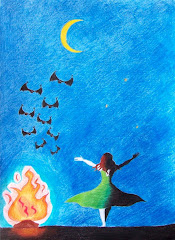
The Laughter of Women

The Laughter Of Women
The laughter of women sets fire
to the Halls of Injustice
and the false evidence burns
to a beautiful white lightness
It rattles the Chambers of Congress
and forces the windows wide open
so the fatuous speeches can fly out
The laughter of women wipes the mist
from the spectacles of the old;
it infects them with a happy flu
and they laugh as if they were young again
Prisoners held in underground cells
imagine that they see daylight
when they remember the laughter of women
It runs across water that divides,
and reconciles two unfriendly shores
like flares that signal the news to each other
What a language it is, the laughter of women,
high-flying and subversive.
Long before law and scripture
we heard the laughter, we understood freedom.
~Lisel Mueller~
Image from Photobucket
Wednesday, April 7, 2010
I heard the crocus laughing

First Crocus
This morning, flowers cracked open
the earth’s brown shell. Spring
leaves spilled everywhere
though winter’s stern hand
could come down again at any moment
to break the delicate yolk
of a new bloom.
The crocus don’t see this as they chatter
beneath a cheerful petal of spring sky.
They ignore the air’s brisk arm
as they peer at their fresh stems, step
on the leftover fragments
of old leaves.
When the night wind twists them to pieces,
they will die like this: laughing,
tossing their brilliant heads
in the bitter air.
Tuesday, April 6, 2010
Ode to Olive Oil

I love olive oil. Really. I do. I use it almost exclusively when cooking. I tend to use the Kalamata oil, but will use anything which has that deep, rich flavor - and I like it when the color is green, not yellow.
I also love the poetry of Pablo Neruda who wrote his odes about everyday things. Olive Oil was no exception.
Cereal, de las olas Del viento en las avenas El olivo De volumen plateado Severo en su linaje En su torcido Corazón terrestre: Las Gráciles Olivas Pulidas Por los dedos Que hicieron La paloma Y el caracol Marino: Verdes, Inumerables, Purísimas Pezones De la naturaleza, Y allí En Los secos Olivares Donde Tan solo Cielo azul con cigarras Y tierra dura Existen Allí El prodigio La cápsula Perfecta De la oliva Llenando Con sus constelaciones el foliaje Más tarde Las vasijas, El milagro, El aceite. Yo amo Las patrias del aceite Los olivares De Chaeabuco, en Chile En la mañana Las plumas de platino Forestales Contra las arrugadas Cordilleras. En Anacapri, arriba, Sobre la luz tirrena La desesperación de los olivos Y en la mapa de Europa España Cesta negra de aceitunas Espolvoreada por los azahares Como por una ráfaga marina Aceite Recóndita y suprema Condición de la olla Pedestal de perdices Llave celeste de la mayonesa Suave y sabroso Sobre las lechugas Y sobrenatural en el infierno De los arzo bispales pejerreyes Nuestro coro Con Intima Suavidad poderosa Cantas: Eres idioma Castellano Hay sílabas de aceite Hay palabras Útiles y olorosas Como tu fragrante material. No solo canta el vino También canta el aceite Vive en nosotros con su luz madura Y entre los bienes de la tierra Aparto Aceite, Tu inagotable paz, tu esencia verde Tu colmado tesoro que desciende Desde los manantiales del olivo. | In the grain fields, of the waves Of wind in the oat-stalks The olive tree With its silver-covered mass Severe in its lines In its twisted Heart in the earth: The graceful Olives Polished By the hands Which made The dove And the oceanic Snail: Green, Inumerable, Immaculate Nipples Of nature And there In The dry Olive Groves Where Alone The blue sky with cicadas And the hard earth Exist There The prodigy The perfect Capsules Of the olives Filling With their constellations, the foliage Then later, The bowls, The miracle, The olive oil. I love The homelands of olive oil The olive groves Of Chacabuco, in Chile In the morning Feathers of platinum Forests of them Against the wrinkled Mountain ranges. In Anacapri, up above, Over the light of the Italian sea Is the despair of olive trees And on the map of Europe Spain A black basketfull of olives Dusted off by orange blossoms As if by a sea breeze Olive oil, The internal supreme Condition for the cooking pot Pedestal for game birds Heavenly key to mayonaise Smoothe and tasty Over the lettuce And supernatural in the hell Of the king mackerals like archbishops Our chorus With Intimate Powerful smoothness You sing: You are the Spanish Laguage There are syllables of olive oil There are words Useful and rich-smelling Like your fragrant material It's not only wine that sings Olive oil sings too It lives in us with its ripe light And among the good things of the earth I set apart Olive oil, Your ever-flowing peace, your green essence Your heaped-up treasure which descends In streams from the olive tree. |
Sunday, April 4, 2010
Happy Easter, Happy Spring!!

My very Catholic Auntie Anne always sent me an Easter card which stated Happy Easter, Happy Spring; she never sent me a religious card. She always included the secular world in her beliefs, something I appreciated. And all of her devotions were to Mary, leading me to believe that she had a secret broom closet in her home that she showed no one!
She's been gone 5 years this May and, every holiday, I still expect to find a card in the mail from her....
Happy Easter, Happy Spring, everyone! Enjoy the day, don't eat too many of those peeps and chocolate bunnies!!
Image from Photobucket.
Friday, April 2, 2010
Morning has broken...

School Prayer
In the name of the daybreak
and the eyelids of morning
and the wayfaring moon
and the night when it departs,
I swear I will not dishonor
my soul with hatred,
but offer myself humbly
as a guardian of nature,
as a healer of misery,
as a messenger of wonder,
as an architect of peace.
In the name of the sun and its mirrors
and the day that embraces it
and the cloud veils drawn over it
and the uttermost night
and the male and the female
and the plants bursting with seed
and the crowning seasons
of the firefly and the apple,
I will honor all life
—wherever and in whatever form
it may dwell—on Earth my home,
and in the mansions of the stars.
~Diane Ackerman~
Image from Photobucket
Thursday, April 1, 2010
It's April Fool's Day!!

A few ways this day is celebrated around the world and why it's good to laugh!
Iranians play jokes on each other on the 13th day of the Persian new year (Norouz), which falls on April 1 or April 2. This day, celebrated as far back as 536 BC, is called Sizdah Bedar and is the oldest prank-tradition in the world still alive today; this fact has led many to believe that April Fools' Day has its origins in this tradition.[4]
The April 1 tradition in France and French-speaking Canada includes poisson d'avril (literally "April's fish"), attempting to attach a paper fish to the victim's back without being noticed. This is also widespread in other nations, such as Italy (where the term Pesce d'aprile (literally "April's fish") is also used to refer to any jokes done during the day). In Spanish-speaking countries, similar pranks are practiced on December 28, día de los Santos Inocentes, the "Day of the Holy Innocents". This custom also exists in certain areas of Belgium, including the province of Antwerp. The Flemish tradition is for children to lock out their parents or teachers, only letting them in if they promise to bring treats the same evening or the next day.
In Poland, prima aprilis ("April 1" in Latin) is a day full of jokes; various hoaxes are prepared by people, media (which sometimes cooperate to make the "information" more credible) and even public institutions. Serious activities are usually avoided. This conviction is so strong that the anti-Turkish alliance withLeopold I signed on April 1, 1683, was backdated to March 31.
In Scotland, April Fools' Day is traditionally called Hunt-the-Gowk Day ("gowk" is Scots for a cuckoo or a foolish person), although this name has fallen into disuse. The traditional prank is to ask someone to deliver a sealed message requesting help of some sort. In fact, the message reads "Dinna laugh, dinna smile. Hunt the gowk another mile". The recipient, upon reading it, will explain he can only help if he first contacts another person, and sends the victim to this person with an identical message, with the same result.
In Denmark the 1st of May is known as "Maj-kat", meaning "May-cat", and is identical to April Fools' Day, though Danes also celebrate April Fools' Day ("aprilsnar").
In Spain and Ibero-America, an equivalent date is December 28, Christian day of celebration of the Massacre of the Innocents. The Christian celebration is a holiday in its own right, a religious one, but the tradition of pranks not, though the latter is observed yearly. After somebody plays a joke or a prank on somebody else, the joker usually cries out, in some regions of Ibero-America: "Inocente palomita que te dejaste engañar" (You innocent dove that allowed to get yourself fooled), as a popular expression. In Spain is common to say just "¡Inocente!" (Innocent!).
From Wiki
Is there anything better than a contagious giggle that you absolutely can’t control? (Ok, maybe not so good in school or church.) Laughter works wonderfully well in the moment, but it also has some surprising long-term health benefits. In the book A Better Brain at Any Age: The Holistic Way to Improve Your Memory, Reduce Stress, and Sharpen Your Wits (Conari Press, 2009), author Sondra Kornblatt explores how laughter can truly make you feel better.
She writes that the new field of gelotology is exploring the benefits of laughter. It was brought to the public’s awareness in Norman Cousins’ memoir Anatomy of an Illness. Cousins found that comedies, like those of the Marx Brothers, helped him feel better and get some pain-free sleep. That’s because laughter helps the pituitary gland release its own pain-suppressing opiates.
What can laughter do?:
- Lower blood pressure
- Increase vascular blood flow and oxygenation of the blood
- Give a workout to the diaphragm and abdominal, respiratory, facial, leg, and back muscles
- Reduce certain stress hormones such as cortisol and adrenaline
- Increase the response of tumor- and disease-killing cells such as Gamma-interferon and T-cells
- Defend against respiratory infections–even reducing the frequency of colds–by immunoglobulon in saliva.
- Increase memory and learning; in a study at Johns Hopkins University Medical School, humor during instruction led to increased test scores
- Improve alertness, creativity, and memory
Humor and creativity work in similar ways, says humor guru William Fry, M.D., of Stanford University–by creating relationships between two disconnected items, you engage the whole brain.
Humor works quickly. Less than a half-second after exposure to something funny, and electrical wave moves through the higher brain functions of the cerebral cortex. The left hemisphere analyzes the words and structures of the joke; the right hemisphere “gets” the joke; the visual sensory area of the occipital lobe creates images; the limbic (emotional) system makes you happier; and the motor sections make you smile or laugh.
So let’s laugh. What makes you laugh? Tell us your favorite funny movie, or how about a good joke?
From the Care2 folks.
Subscribe to:
Posts (Atom)




 Posts
Posts